Both Things Are True
Cancer care is much better and still brutal; climate outlooks have improved and remain dangerous; Silicon Valley has energy and may have lost something human.

Healthcare: cancer progress but still hard
Disability: being human, representing atypical language
Climate: progress, half-full or half-empty
Dan Wang on silicon valley
Brian Wang on viruses, ARIA programme
Links (end): AI capability, institutional governance, regulation, prediction markets, research tools, and AI-native startups.
This week’s letter is about complicated progress. Cancer care is much better than it was, and still painfully hard to endure. Climate outlooks have improved, and still imply serious damage. Silicon Valley has optimism, money and technical energy, but may have lost culture. China can build at astonishing speed, but also has culture/moral challenges.
I’ve been thinking a lot about healthcare in the last few weeks. Well. I think about healthcare a lot by default, as investing in healthcare means I do a few hours a day on healthcare research on average! But theory and desk work have a different quality versus when it touches one’s physical and tangible world.
Swimming in the back of my mind is my conversation with my friend Salima on her cancer recovery. 20 years ago this process of chemo to shrink tumour small enough to cut out, then cut out and have the all clear would not have had a high chance of working. Now the chances are good.
In the US, where there is decent data we can see US age-adjusted cancer mortality has fallen by 34% from 1991 to 2022, averting about 4.5 million deaths, and five-year survival for distant-stage cancers in the US has doubled from 17% in the mid-1990s to 35% for diagnoses in 2015–2021.

Still. While relative improvements have increased, the absolute numbers are still low. Distant lung cancer only has 1 in 10 with a 5 year survival rate, great that it is up from 2% to 10% but still very low.
New drugs are increasing in this area. Average annual FDA approvals of oncology and hematology new molecular entities rose from 3.5 per year in 1998–2010 to 12.2 per year in 2011–2024.
Note, when a drug enters phase 1 human clinical trials, the chance that it will make it to market is in the order of only 10%, and it still takes 5 to 10 years (occasionally quicker in exceptional circumstances) to make it, at a cash cost of between $200m to $1bn dollars; and an all-in (risk and opportunity cost) of double that.
Biopharma people tell me (and I assess myself) that AI will speed this up, although still some time away from a 10x improvement. I think a 5 percentage point improvement in success (at phase 1) from 10% on average to 15% and cutting 2 to 3 years from timelines would be a pretty great and just about plausible achievement, although this will take at least 10 years to nudge towards. The AI people who see clinical times reducing even further than that, do not understand enough about biology and human trial bottleneck, although one day much further in the future, we might get there.
I have another friend who told me about a recent late stage lung cancer diagnosis. She is my age. While I have dealt with this area in my Bigly Death show and have all the theoretical knowledge on latest lung cancer treatments, it still makes my ponder on the time we have, what makes us human and what we should be spending our time on.
Another area that has popped up, and I keep bumping into, is around British education and disability educational needs. I continue to note the range of views that my university friend, Naomi Fisher, highlights via her podcast and blog. (She attracts criticism from many sides for highlighting a range of views, from those still operating inside the medical model (eg Uta Frith) to those who espouse the social model).
One area I had not thought about enough until it entered my life is in interacting and representing people who can not easily advocate for themselves. Stephen Unwin wrote a book about it (Beautiful Lives, Amazon Link)
For much of history, people with learning disabilities have been regarded as unworthy of interest - often seen as a threat to the social order and sometimes dismissed as barely human. While recent years have seen an improvement, learning-disabled people are still treated as fundamentally different. Beautiful Lives is a personal and pragmatic account, told through the eyes of a father whose son has severe learning disabilities.
and mentioned it on our podcast (if your speech is absent or atypical, then how are you represented?). There is a classic psychology / science / philosophy question which interrogates whether language is an important or even the only differentiator between humans and animals. We should not treat humans who don’t have conventional means of communication poorly, but overall we do not do well in this regard.
I don’t have fully developed thoughts here but I feel it is a serious issue that is often hidden from public view and remains under-grappled with by society at large.
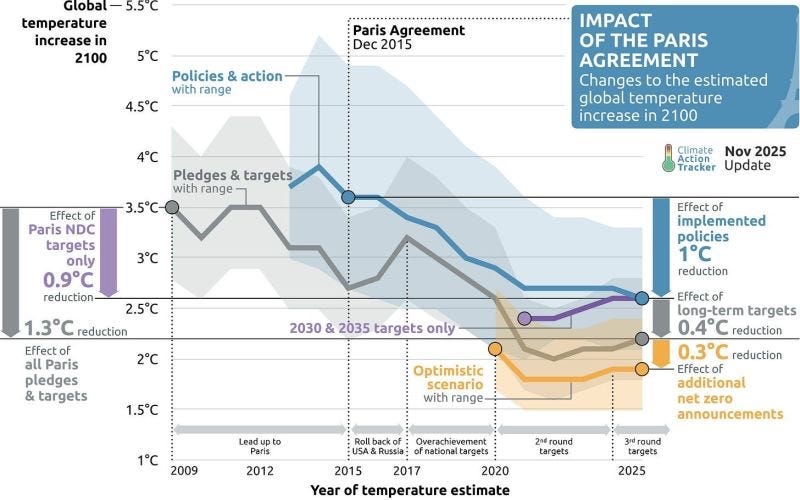
In climate world, there has been discussion of the high end climate scenario, known as RCP 8.5, being retired. RCP 8.5 was pointing towards a 4c world. It was already known for a few years that RCP 8.5 was not very plausible. I discuss this with Zeke Hausfather in my pod in 2021 where we already concluded RCP 8.5 not likely. Median policy (see above) is hovering in the 2.5c to 3c range of scenarios with upside to the 2c to 2.5c range as plausible.
Zeke Hausfather comments: ...two things can be true at the same time:
RCP8.5 (and its successor SSP5-8.5) were designed to be a worst case emissions scenario, not the most likely outcome even in a world that did nothing to address climate change. We were probably never headed to a tripling of global emissions by 2100 (to say nothing of a five-fold increase in coal use), even in the absence of climate policy.
Rapid declines in clean energy costs have bent the curve of future emissions downward, with new scenarios designed to reflect current policies notably lower than most baseline scenarios in the literature. The 21st century is now unlikely to see a continued expansion of fossil fuel use globally, with current policy scenarios reflecting relatively flat global emissions going forward.
Me. The counterfactual is hard but it seems that current base scenario estimate is for a 2.5c to 3c outlook.
And it is also plausible that both technology progress and policy progress has lead to 0.7c drop in warming outlook (maybe even more) compared to outlook in 2015 or so.
Zeke concludes: “A tripling of global CO2 emissions by 2100 may never have been particularly plausible even back in 2011 when RCP8.5 was originally published. But a 21st century of increasing fossil fuel use leading to a doubling of emissions was within the realm of the possible. The fact that we are no longer heading toward that is a sign of progress, rather than somehow undermining the edifice of all of climate science as both President Trump and some overly excited internet pundits claim. And of course, we still have a long way to go to get emissions down to (net) zero and stabilize global temperatures.” Link to his blog.
I suppose it is hard for people to keep these two ideas in mind, but from a climate perspective it means that the future outlook has become better, materially better (by 0.5c to 1c range) due to policy and technology (although some still argue impact has been more limited) but that there will still be significant damage that it would be better to adapt and mitigate etc. for at these current median scenario ranges of 2.5c to 3c. Both things are true. Here is BBC 9 minutes on it as well.
I had an excellent chat with Dan Wang which is now out. Dan has lived in and comments on China and the US in his best selling book Breakneck. We do go pretty off-piste into theatre and food.
We start on whether / why Silicon Valley has lost its sense of humour. We think it probably has…. The ideas is that…Humour requires looseness, self-mockery, tolerance of ambiguity, and the ability to puncture status. If Silicon Valley has lost that, it may signal a deeper narrowing of personality and imagination. We suggest this as a shift from earlier countercultural playfulness toward harder-edged founder seriousness…. We think SV contrats with NYC and London as it doesnt understand culture in the same way…
Dan suggests: Silicon Valley has optimism, money, technology and energy, but thinner cultural life; London has theatre, conversation, museums, music, food, soft power and social sparkle, but lacks optimism and cannot build. … I still remain in the minority of being optimistic on London, and suggesting it can solve some building problems, but Dan is not convinced…
On China… Dan gives China enormous credit for physical achievement, but argues that censorship, weak journalism, falling reading habits, and constrained artistic production are flattening cultural life. I add…China’s physical engineering has been extraordinary, but its social-political engineering may be the medium-term weakness. This weakness might be fatal, in particular: its one child policy.
We have a ‘food becomes a theory of society’ discussion… Dan notes in China food delivery is a metaphor for optimisation: speed, standardisation, platform logistics, and central kitchens can make delivery astonishingly efficient while subtly worsening cuisine. That mirrors the wider China argument: extreme operational competence can produce hidden cultural costs.
Dan also suggests that immigrants are especially able to appreciate what works and what fails and it makes us the best cultural critics!
We also have a great section on writing-craft (copying out prose, keeping a phrase scrapbook, writing plays by hand, reading dialogue aloud, and noticing punctuation is one of the richest sections for your literary audience) and Dan argues knowing which rules to break is an important life advice idea!
I also had a brilliant chat with Brian Wang on the frontier of viral research. We moved across innate immunity, respiratory viruses, AI in biology, and why some scientific fields suddenly become ready to engineer.
The conversation stayed with me because of the broader idea: perhaps medicine can move beyond one-virus-at-a-time defence and toward something closer to durable biological resilience.
Most of us think about immunity through the lens of vaccines, antibodies and T-cells. That is the adaptive immune system: highly specific, targeted, and enormously powerful. But Brian is working on the other side of the immune system: innate immunity. This is the faster, broader, older part of our defence system. It is less precise, harder to tune, and historically harder to engineer safely. But it may also be better suited to defending against many different viruses at once.
One thought on the chat was how fields develop, they don’t move in a straight line from unknown to solved. They pass through phases, then progress when ideas, data, tools are developed enough to create new ideas and to test.
Another thought was on the purpose of ARIA. ARIA is trying to shape a whole opportunity space. A conventional startup might pursue one modality. A pharma company might wait until the commercial path is clearer. A university grant might fund one narrow academic question. ARIA can back a portfolio of approaches: DNA, RNA, proteins, small molecules, trained-immunity vaccines, delivery technologies, academic groups, startups and unusual teams.
That is a different model of innovation. It says that some problems need an ecosystem before they can become a market.
This is especially important in frontier science because early categories are often misdescribed. Before there is a product category, there is a cluster of half-formed questions. What is the right modality? What is the right safety margin? What should be measured? Which model systems are predictive? Where does biology cooperate, and where does it resist? A good funder at this stage is not just buying answers. It is helping create the conditions in which better questions can be asked.
We also remain positive on the UK!
Ben speaks with Brian Wang, Programme Director at ARIA, about one of the most ambitious ideas in biotechnology: using the innate immune system to create a new class of preventive medicines that could protect against multiple respiratory viruses at once. At the centre of the conversation is ARIA’s Sustained Viral Resilience programme, which aims to develop “sustained innate immuno-prophylactics” or SIPs: potential medicines that could provide months of protection against a wide range of respiratory infections from a single dose.
“Your immune system is just an amazing kind of laboratory in and of itself.”
Quick hit links:
OpenAI model solves something hard in maths. I do think this is another notable milestone.
Jamie Dimon (JP Morgan CEO) on what to ask a board rather than a tick box Chair/CEO split and LI comments on why this is an issue in the UK.
Social Media ban in Australia not working. NBER paper (LI post). I know people (mainly certain parents) feel very strongly about this, but I wish they would look more closely at the data and, even if it is still concluded that this is worth doing, come up with a better solution, such as using parental control features. I’ve blogged about this previously and it has nudged me further into classic liberal thinking.
AI LLMs and writing style paper (Ethan Mollick tweet).
Sharps on prediction markets (NYT)
Johan Fourie token efficient Claude skill on collating papers. (I’ve not tested) but seems good. X post.
YC on experiences building self-improving, AI-native companies. X-post. Many are going to fail, but I judge that a new breed of companies will be coming through this decade.